
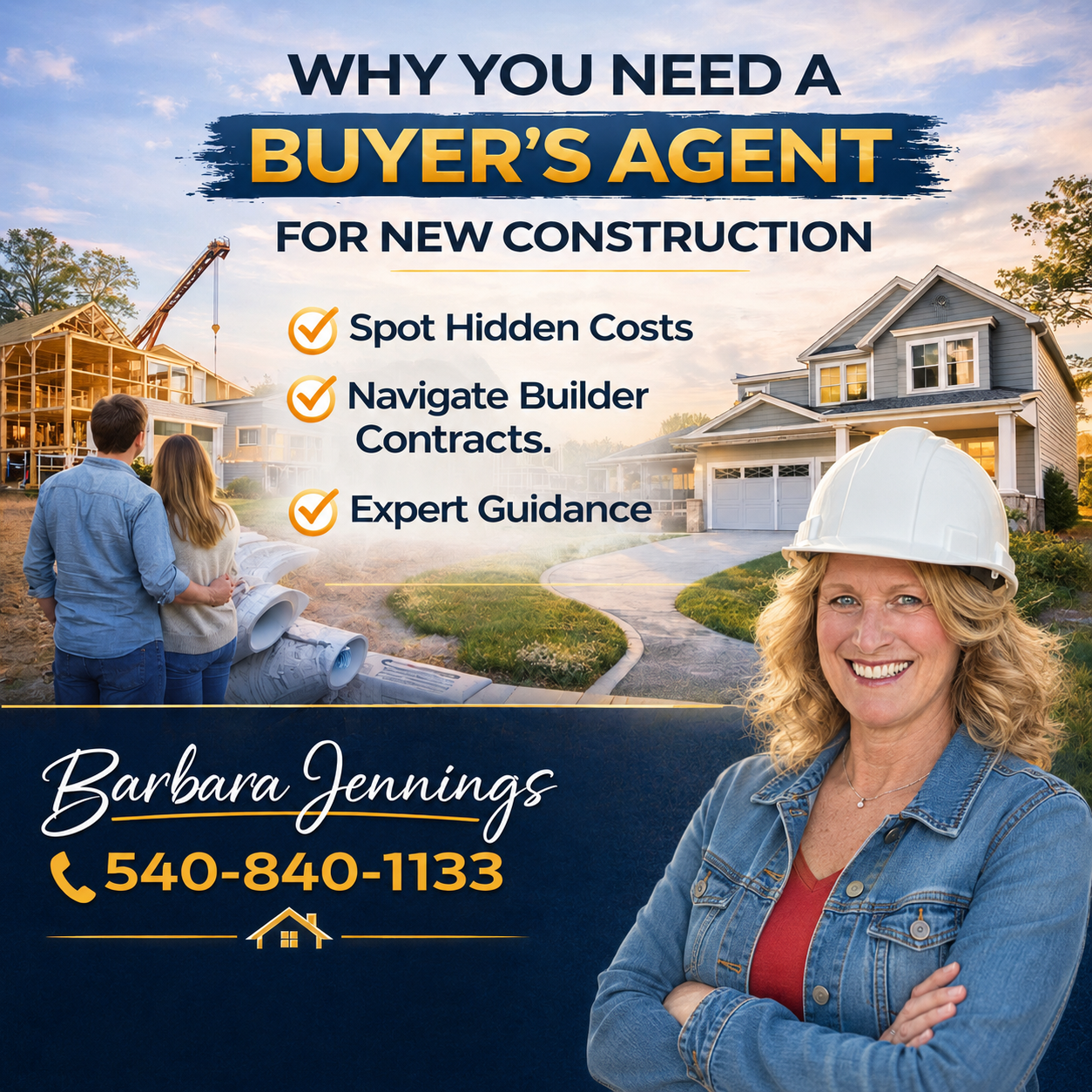
The question comes up in almost every new construction conversation: do I really need a realtor when the builder has a whole sales team ready to help me? It is an important question, because the answer shapes everything that follows, from the contract you sign to the inspections you schedule to the incentives you get credit for. Here is the honest breakdown of why representation matters on a new build, what an agent actually does, and the one rule that can save your representation before you ever tour a model home.
Do You Legally Need a Realtor to Buy New Construction?
No. In Virginia, you are not legally required to use a realtor to purchase a new construction home, any more than you are for a resale home. You can absolutely walk into a sales office, choose a floor plan, sign the builder's contract, and close on the home on your own. It happens every day, and plenty of buyers do it successfully.
But "legally required" and "smart to do" are very different questions. New construction contracts are long, dense documents written by the builder's legal team, and they are one-sided by design. The question buyers should really be asking is not whether an agent is required, but whether they want a licensed professional whose only job is to protect their interests through a process that is more complex than most people expect.
Why Doesn't the On-Site Sales Representative Represent You?
This is the fact that surprises most buyers: the friendly, knowledgeable person greeting you at the model home does not work for you. The builder's sales representative works for the builder, is paid by the builder, and is trained to sell homes on the builder's terms. They know the floor plans, the upgrade packages, and the current incentives inside and out, and they genuinely want you to be happy with your purchase. But they cannot advise you on whether a contract clause is fair to you, whether an incentive could be stronger, or whether this community is the right financial fit for your family. Their loyalty is to the builder.
Your buyer's agent, by contrast, has a fiduciary duty to you. In real estate terms, that means a legal obligation to act in your best interest, not the builder's. When you walk into a model home with your own agent, you have a licensed professional beside you whose only job is to protect you through every stage of the transaction.
Sales Representative vs. Your Buyer's Agent
The Builder's On-Site Sales Representative
- Works for the builder and is paid by the builder
- Can explain floor plans, upgrades, and current pricing
- Cannot advise you on contract fairness or negotiation strategy
- Represents one community, not your whole set of options
- Does not owe you a fiduciary duty
Your Buyer's Agent
- Works for you, with a fiduciary duty to protect your interests
- Reviews the builder's contract and flags one-sided terms
- Negotiates incentives, upgrades, and terms on your behalf
- Coordinates inspections and tracks construction milestones
- Helps you compare builders and communities impartially
- Stays with you through the design center, walk-throughs, and closing
What Does an Agent Actually Do Through the New-Build Process?
A buyer's agent's job does not end when you go under contract. On a new build, that is often where the real work begins. Here is what representation looks like at each stage of the process.
1 Contract Review
Builder contracts come with addenda that can bury important details: escalation clauses, timeline language, deposit terms, what happens if financing changes, and what the builder can change before closing. Your agent reads every page, explains what it means, and negotiates changes that protect you before you sign.
2 Incentives and Upgrades
Builders routinely offer rate buydowns, closing-cost credits, and design center allowances, and those offers change constantly. Your agent helps you compare what is genuinely on the table, asks for a better package when the market allows, and keeps the design center conversation anchored to your budget. This is why the buyer's agent conversation matters right before you sign.
3 Inspections
Independent third-party inspectors can check the framing, electrical, plumbing, and HVAC before the drywall goes up, plus a final inspection before closing. Your agent coordinates the timing and reviews the reports with you so small issues get fixed on paper, not after move-in.
4 Registration and Representation
Builders almost always require your agent to be registered on your first visit. Reach out before you tour any community so you are covered from the moment you walk in, and if you are reading this after touring on your own, ask whether representation can still be added. Every builder handles this differently.
5 Walk-Throughs and Closing
The final walk-through is your last chance to catch problems before you own them. Your agent checks that every upgrade you paid for is installed, documents anything unfinished on a punch list, reviews the closing statement, and works with the lender and settlement company so nothing falls through the cracks.
The One Rule That Can Save Your Representation
Bring Barbara to the model home on your first visit. If you tour a community on your own and leave your contact information, many builders will treat you as an unrepresented buyer and decline to work with your agent later. Reach out before you visit, not after.
Planning to tour a model home this weekend?
Text or call Barbara Jennings at (540) 840-1133, or book time on her calendar.
Who Pays for Your Buyer's Agent on a New Build?
This is the question buyers ask most, and the answer is usually good news. In most new construction transactions in Virginia, the builder pays the buyer's agent's compensation at closing, which means representation is typically not an out-of-pocket cost to you. The builder accounts for that cost in its marketing budget, and the price of the home does not go up because you have an agent.
Going direct does not usually save you money either: the builder does not typically discount the price because you skipped representation. You are not trading an agent for a better price. You are deciding whether a professional negotiator sits on your side of the table. For the full breakdown of how the commission actually works, read who pays the buyer's agent on a new build.
Does Representation Matter for Quick Move-Ins Too?
Absolutely. A quick move-in home is finished or nearly finished, which means you can skip the long build wait, but you still face a builder's contract, incentives, inspections, and a walk-through. The same first-visit registration rule applies. Learn more in our guide to what a quick move-in home is.
Should You Buy New or Resale? Representation Helps Either Way
Whether you end up in a brand new build or a resale home, having your own agent on your side is the safest path. If you are weighing the two, our balanced comparison of new construction vs. a resale home lays out the trade-offs so you can decide with clear eyes.
Frequently Asked Questions
Bring Barbara to the Model Home on Your First Visit
Text or call Barbara Jennings at (540) 840-1133 before you tour any community, and she will make sure you are registered as a represented buyer from day one. She serves new construction buyers across Fredericksburg, Stafford, Spotsylvania, Orange, Fairfax, and Prince William County.
People Also Ask
Buyers search for these questions alongside this one. Here are the direct answers.
What happens if I tour a model home without an agent?
If you tour on your own and sign in or leave your contact information, many builders treat you as an unrepresented buyer and may decline to pay an agent you bring in later. Connect with an agent before your first visit so you are registered from day one.
Does the builder pay my buyer's agent?
In most new construction transactions in Virginia, the builder pays the buyer's agent's compensation at closing, so representation is typically not an out-of-pocket cost. Confirm the details before you sign and before your first tour.
Can I visit builders first and add an agent later?
Sometimes, but it depends on the builder and how you were registered. Once you sign in on your own, many builders will not allow an agent to be added afterward. The safe move is to have representation in place before the first visit.
What does a buyer's agent actually do on a new build?
An agent reviews the builder's contract and addenda, negotiates incentives and upgrades, coordinates inspections like the pre-drywall review, tracks the build, and walks the final walk-through with you through closing.
Is a realtor worth it if the builder's sales office is helpful?
The sales representative is knowledgeable but works for the builder and cannot advise you on contract fairness or negotiation strategy. A buyer's agent has a legal duty to protect your interests, and in most transactions the builder pays for that protection.
New Construction in the Fredericksburg, VA Area
When you are buying new construction around Fredericksburg, the registration rule applies in Stafford and Spotsylvania county communities exactly as it does in the city itself: builders across the region typically require your agent to be registered on your first model home visit.
New construction is a constant across the Fredericksburg, Virginia area. Buyers find active communities in Fredericksburg itself and in the neighboring counties of Stafford and Spotsylvania, each with its own mix of builders, price ranges, and commute options. Stafford and Spotsylvania sit close to I-95 and the Virginia Railway Express, which makes them a practical choice for commuters, while Fredericksburg offers a historic downtown with easy access to the same routes.
Whatever the topic and whichever community you are considering, the same basics hold true across the region: bring your agent to the first model home visit so you are registered as a represented buyer, ask for the builder's standard-features list and the current written incentives, and review the contract and warranty before you sign. Barbara works with buyers in Fredericksburg, Stafford, and Spotsylvania, and she can point you to the communities that match your budget and commute.
Related Reading
- Browse new construction builders in Virginia
- Do You Need a Buyer's Agent for New Construction?
- Hampstead in Stafford, VA: Semi-Custom Homes on Wooded Acreage
More New Homebuyer Questions
Barbara Jennings
REALTOR® · eXp Realty · Virginia License 0225179074
Barbara helps buyers navigate new construction in the Fredericksburg, VA area, including Stafford and Spotsylvania counties, plus Orange, Fairfax, King George, Caroline, Culpeper, Arlington, Alexandria, and Prince William County.
Call or Text (540) 840-1133Last updated: October 23, 2026.