
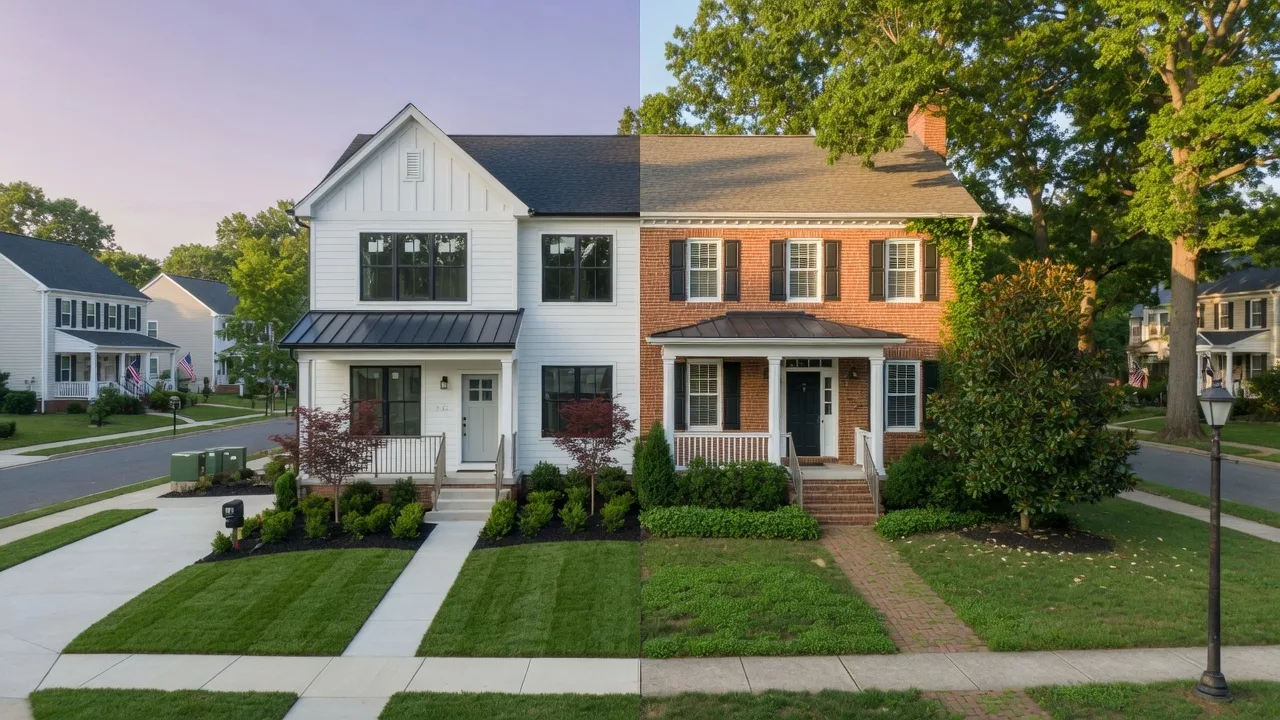
Every buyer I work with in the Fredericksburg, Stafford, and Spotsylvania area eventually faces the same big question: should I buy new construction or an existing home? It's one of the most important decisions you'll make in your home search, and there's no universal right answer. What works for a first-time buyer on a tight timeline may be completely wrong for a growing family looking to customize every detail of their dream home. In this guide, I'll walk you through the key differences between new construction and existing homes across every dimension that matters — cost, timeline, customization, quality, location, and resale value — so you can make the choice that fits your life.
The Big Picture: Two Very Different Paths
At the most basic level, the choice comes down to this: new construction offers a home no one has ever lived in, built to modern standards with your choice of finishes, located in a master-planned community with brand-new amenities. An existing home offers an established neighborhood with mature trees, a proven floor plan, immediate move-in availability, and often a lower price per square foot.
In the Fredericksburg region specifically, you have strong options on both sides. New construction communities from Ryan Homes, D.R. Horton, Lennar, Toll Brothers, and Stanley Martin are active across Stafford, Spotsylvania, Orange, and Prince William counties. At the same time, the resale market in established neighborhoods like Fredericksburg's historic district, Stafford's Aquia Harbour, and Spotsylvania's Lake of the Woods offers well-maintained homes with track records of appreciation. Let's break down the comparison category by category.
Cost Comparison: Purchase Price, Upgrades, and Hidden Expenses
On the surface, existing homes generally cost less per square foot than new construction — but the full financial picture is more nuanced. Here's what to consider:
| Cost Factor | New Construction | Existing Home |
|---|---|---|
| Purchase Price (Fredericksburg area) | $400K–$800K+ (varies by community) | $350K–$650K (varies by neighborhood) |
| Upgrades / Customization | $10K–$50K+ beyond base price | $5K–$30K for immediate updates |
| Immediate Repairs | Minimal — everything is new | $2K–$15K+ (roof, HVAC, plumbing age dependent) |
| Utility Costs (Monthly) | Lower — modern insulation, windows, HVAC | Higher — older systems, less efficient envelope |
| HOA Fees | $50–$200+/mo (new community amenities) | $25–$150/mo (varies widely) |
| Builder Incentives | Often available: closing cost assistance, rate buydowns, design credits | Not available — negotiate with seller |
The key insight? Your total cost of ownership matters more than the purchase price alone. A new construction home with energy-efficient systems can save you hundreds of dollars a month in utilities compared to a 30-year-old home with original windows and an aging HVAC system. Over five years, those savings can easily offset the higher upfront price. On the flip side, an existing home in an established neighborhood may require less landscaping, no lot premium, and no design center upgrades — making it more predictable from a budgeting standpoint.
Timeline: When Do You Need to Move In?
This is often the deciding factor for my buyers. Here's a realistic breakdown of what to expect:
New Construction
- → Lot selection to closing: 6–14 months
- → Design center appointment: 2–6 weeks after contract
- → Quick move-in homes available in some communities (30–60 days)
- → Delays possible: weather, supply chain, permit backlogs
Existing Home
- → Offer to closing: 30–60 days
- → Move-in ready as soon as you close
- → No waiting for construction or design center
- → Risk: competing with other buyers or losing in multiple-offer situations
If you're on a tight timeline — relocating for a job, selling your current home quickly, or needing to move before the school year starts — an existing home is almost always the faster option. New construction quick move-in homes can help bridge the gap in some communities, but inventory is limited. If you have flexibility and can plan 9 to 14 months ahead, new construction gives you far more control over the outcome.
Customization: How Much Control Do You Want?
For many buyers, this is where new construction wins hands down. When you build, you choose the floor plan, the lot, the elevation, the countertops, the cabinets, the flooring, the paint colors, the light fixtures, and every other finish detail. Your home reflects your personal taste from day one — no need to tear out someone else's beige carpet or update an avocado-green kitchen.
With an existing home, you're buying someone else's vision. You may love the layout but hate the wallpaper. The kitchen may be perfectly functional but feel dated. You can renovate over time — and many buyers do exactly that — but it requires additional investment, contractor management, and living through construction. Some buyers love the challenge of transforming a fixer-upper; others would rather pay a premium for move-in ready perfection.
The middle ground? Some existing homes are already renovated or updated by sellers who did the hard work for you. In competitive markets like Fredericksburg and Stafford, updated homes often command a premium, but they can still offer a faster path to a turnkey home than waiting for a new build.
Quality, Warranties, and Peace of Mind
A new construction home comes with a builder's warranty — typically a 1-2-10 structure (one year for workmanship and materials, two years for systems, and ten years for structural defects). Every major system in the home is brand new: roof, HVAC, water heater, appliances, windows, and wiring. You won't be replacing a 20-year-old furnace in your first winter or dealing with an unexpected roof leak during a summer thunderstorm.
With an existing home, you need a thorough home inspection — and even then, some issues only reveal themselves after you've lived in the house for a few months. An older home's charm often comes with older home problems: settling foundations, outdated electrical panels, galvanized plumbing, or insulation that was adequate in 1985 but falls short of today's standards. The good news is that a good inspection report gives you leverage to negotiate repairs or credits with the seller.
That said, "new" doesn't automatically mean "perfect." New construction homes can have their own issues — incomplete punch list items, builder-grade materials that may not hold up as well as higher-end options, and sometimes rushed construction schedules. That's why the pre-drywall inspection and final walk-through are so critical, and why having an experienced buyer's agent who knows what to look for matters regardless of which path you choose.
Location: Established Character vs. Master-Planned Community
This is one of the most personal trade-offs in the new versus existing debate. Let's look at what each option offers:
New Construction Communities Often Include
- → Brand-new community amenities: pools, clubhouses, playgrounds, walking trails
- → Consistent architectural standards and well-maintained common areas
- → Modern street layouts with sidewalks, streetlights, and underground utilities
- → Often located in growing suburban areas with new schools under construction
- → Phased development — your view may change as new sections are built
Established Neighborhoods Often Offer
- → Mature trees and established landscaping that new communities lack
- → Larger lots and more varied home styles
- → Proximity to downtown Fredericksburg, historic areas, and established commercial corridors
- → Proven school zones with track records and established feeder patterns
- → Known community character — what you see is what you get
In the Fredericksburg area, the location trade-off is especially pronounced. New construction communities tend to cluster on the growing edges of Stafford (along the Route 17 corridor), Spotsylvania (near the Cosner's Corner area), and Orange County (around the Lake of the Woods region). Established neighborhoods like Fredericksburg's historic downtown, Stafford's Aquia Harbour, and Spotsylvania's Lee's Hill offer mature trees, established schools, and immediate access to Route 1, I-95, and the VRE commuter rail. Your commute, lifestyle preferences, and tolerance for ongoing construction in the neighborhood will be major factors in this decision.
Resale Value and Long-Term Appreciation
New construction homes typically depreciate slightly in the first year or two — you're paying a premium for the "new" factor, and once the home is no longer brand new, some of that premium fades. After that initial adjustment, the home's appreciation tends to track the broader market. If you buy in a growing community that fills up quickly, resale values can rise steadily as new phases are built at higher price points.
Existing homes in established neighborhoods have a longer track record. In areas like Fredericksburg's historic district or Stafford's established subdivisions, you can look at 10- and 20-year appreciation trends to gauge long-term value. Established neighborhoods also tend to hold their value better during market downturns — they have a proven desirability that new communities are still building.
That said, both options can be excellent long-term investments in the Fredericksburg area. The region benefits from steady population growth, the I-95 commuter corridor, proximity to Quantico and the Pentagon, and a growing local economy. According to Bright MLS, north-central Virginia is projected to see about 1.5% price appreciation in 2026 — more than the D.C. core metro area. The key is buying a home that fits your lifestyle while being realistic about the market where it's located.
Which Path Is Right for You? A Decision Framework
Here's a simple way to think about it. New construction is often the better choice if:
You want a home that's truly yours from day one
No one else has ever lived in it, and you chose every finish. It's a blank canvas that's exactly how you want it.
You have 9–14 months of flexibility on your move-in date
You can plan ahead, wait for construction, and coordinate your current living situation around the timeline.
Energy efficiency and low maintenance are priorities
Modern building codes, new windows and systems, and a builder's warranty mean less to worry about and lower utility bills.
You want community amenities from day one
Pools, walking trails, playgrounds, and clubhouses are part of the lifestyle package in many new communities.
An existing home is often the better choice if:
You need to move sooner rather than later
If you're relocating, selling your current home quickly, or starting a new job, waiting 9+ months may not be practical.
You value mature trees and established character
New communities take years to develop mature landscaping, and some buyers prefer the established feel of an older neighborhood.
You prefer a known quantity with proven schools and commute times
Established neighborhoods have track records. You can visit schools, time your commute, and talk to current residents before you buy.
You want more buying power for your budget
Existing homes often offer more square footage and larger lots for the same price as a smaller new construction home.
What I See in the Fredericksburg Market
Having guided buyers through both paths across the Fredericksburg, Stafford, Spotsylvania, Orange, Fairfax, and Prince William County areas, here's what I see playing out in the current market:
First-time buyers often lean toward existing homes in the $350K–$450K range, where they can get more square footage and a larger lot than a comparable new construction home. However, the builder incentive packages available in many new communities — closing cost assistance, rate buydowns, and design center credits — can make new construction surprisingly competitive on monthly cost, especially when combined with FHA or conventional one-time close financing.
Move-up buyers (those selling an existing home and upgrading) often gravitate toward new construction, where they can customize a home in the $600K–$900K range with the finishes they've always wanted. In communities like Toll Brothers' Regency at Chancellorsville or D.R. Horton's Rivers Bluff, these buyers appreciate the modern open floor plans, gourmet kitchens, and owner's suite designs that older homes rarely offer without renovation.
Military buyers using their VA benefit face a unique consideration. While the VA one-time close loan is a powerful tool for new construction, the current lender landscape for VA construction loans is more limited than it was a few years ago. Some buyers choose existing homes specifically because VA financing is easier to secure on a completed property with a standard purchase loan.
Investors in the Fredericksburg area tend to favor existing homes in established rental markets like the I-95 corridor, where they can buy at a lower per-square-foot price and achieve positive cash flow immediately. New construction rarely pencils out for rental investors unless they're buying at the base price in a high-appreciation community.
The Bottom Line: There's No Wrong Answer, Only the Right Fit
Both new construction and existing homes have their place in the Fredericksburg-area market. The best choice depends on your timeline, your budget, your tolerance for customization decisions, and your lifestyle priorities. There's no universal right answer — but there is a right answer for you.
What I tell every buyer I work with is this: don't close the door on either option until you've explored both. Tour a few new construction communities and a few existing neighborhoods. Run the numbers side by side, including utilities, taxes, HOA fees, and long-term maintenance costs. And talk to someone who works in the market every day — not just someone who sells one type of home or the other, but a buyer's agent who can give you an honest assessment of what fits your situation.
That's where I come in. Whether you're leaning new construction, existing, or somewhere in between, I'd love to help you explore your options across the Fredericksburg, Stafford, Spotsylvania, Orange, Fairfax, and Prince William County area. Let's figure out the right path together.
"The choice between new construction and an existing home isn't about which one is 'better' — it's about which one is better for you, right now, in this chapter of your life. I help buyers explore both paths with open eyes and find the one that fits."
— Barbara Jennings
When Barbara isn't helping families find their new construction home in Virginia, she's sharing the latest insights on building and buying across the Fredericksburg region. Learn more at barbara-jennings.com.
Not Sure Which Path Is Right for You?
Whether you're leaning new construction, an existing home, or you're just starting to explore your options, I can help you compare your choices and find the right fit. Contact me today for a free consultation.

Barbara Jennings
REALTOR® · eXp Realty · New Construction Specialist
Barbara Jennings is a licensed Virginia REALTOR® with eXp Realty, specializing in new construction, builder negotiations, and the Fredericksburg-area market. With her proven 100-point Marketing Plan and advanced AI-driven strategies, she helps buyers find the right home at the right price — and save thousands in the process.